


PPO - phase 1
exp1: VPG / no-clip baseline on CartPole
- Why run it: This is the vanilla policy gradient that PPO is trying to improve. Getting our baseline.
- What to vary: Nothing. No clipping, no KL penalty, one epoch per batch, no data reuse.
- logs: wandb logs
- What it teaches: Large, unconstrained policy-gradient steps can collapse the policy or destabilize training.
exp2: Add the clipped surrogate objective
- Why run it: Isolate the single most important PPO ingredient.
- What to vary:
epsilon∈ {0.1, 0.2, 0.3}. Also include a “no clip” branch (same as experiment 1). Keep everything else fixed: value baseline, GAE, entropy coefficient, learning rate. - wandb logs
Clipping alone fixed the exp1 collapse: entropy stays ~0.68 and the score doesn’t fall back to random. But the initial clip_fraction reading of 1.0 was a metric bug - we were testing |ratio| > eps instead of |ratio - 1| > eps. Since ratio hovers near 1.0, that test is true almost always. Fixed in code; the cf column is only trustworthy for runs with the _lam suffix (run after the fix).
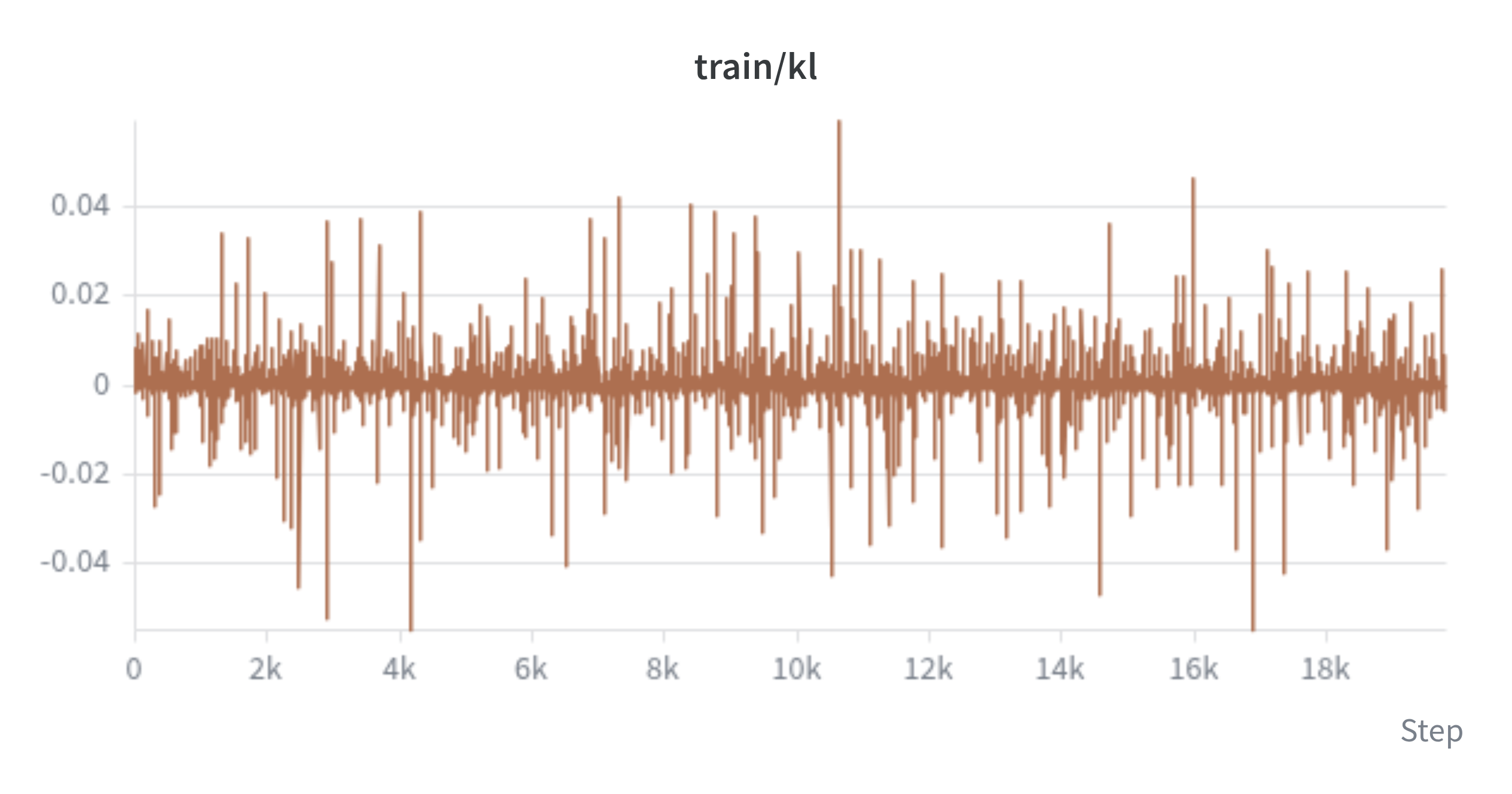
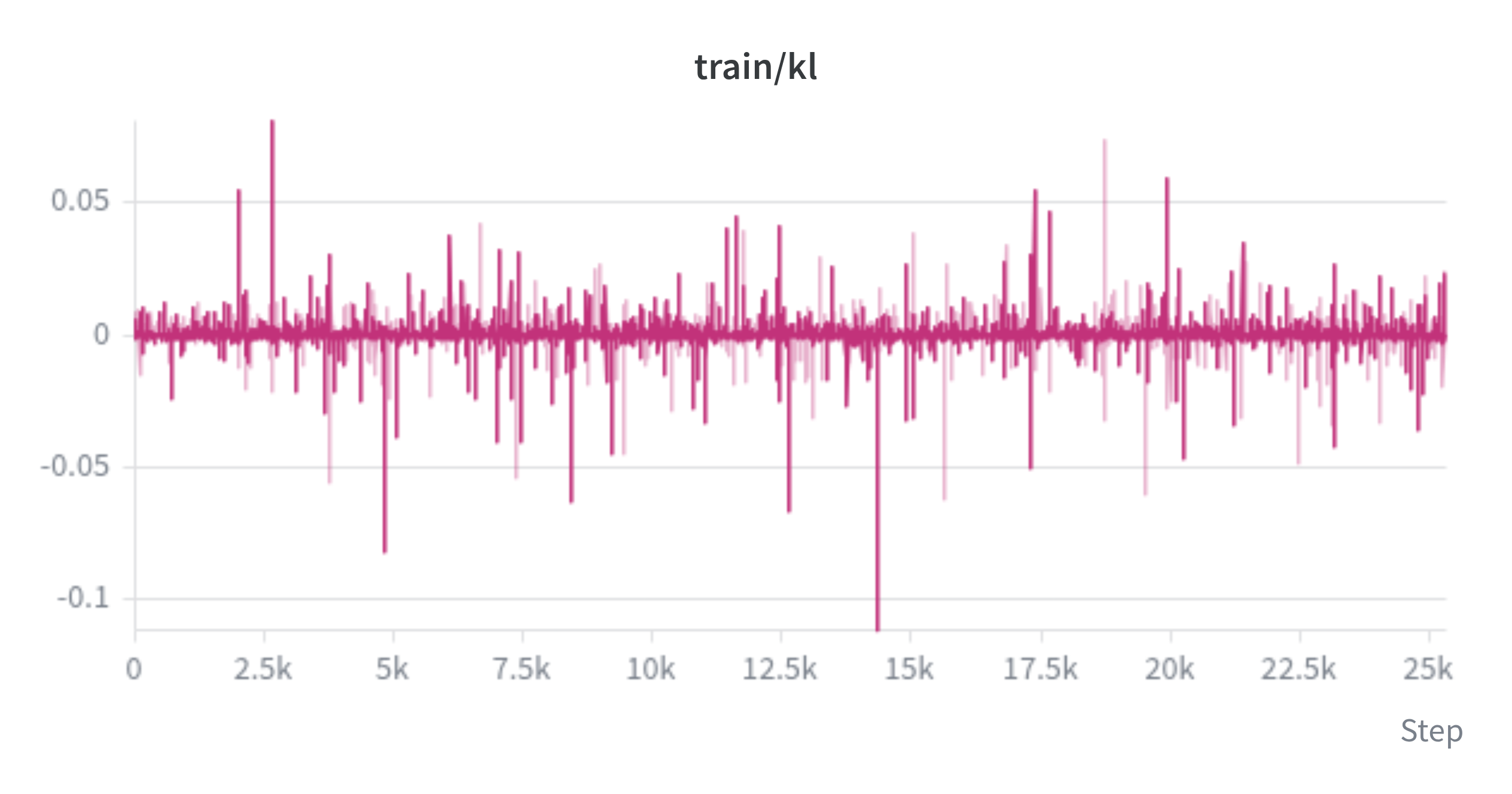
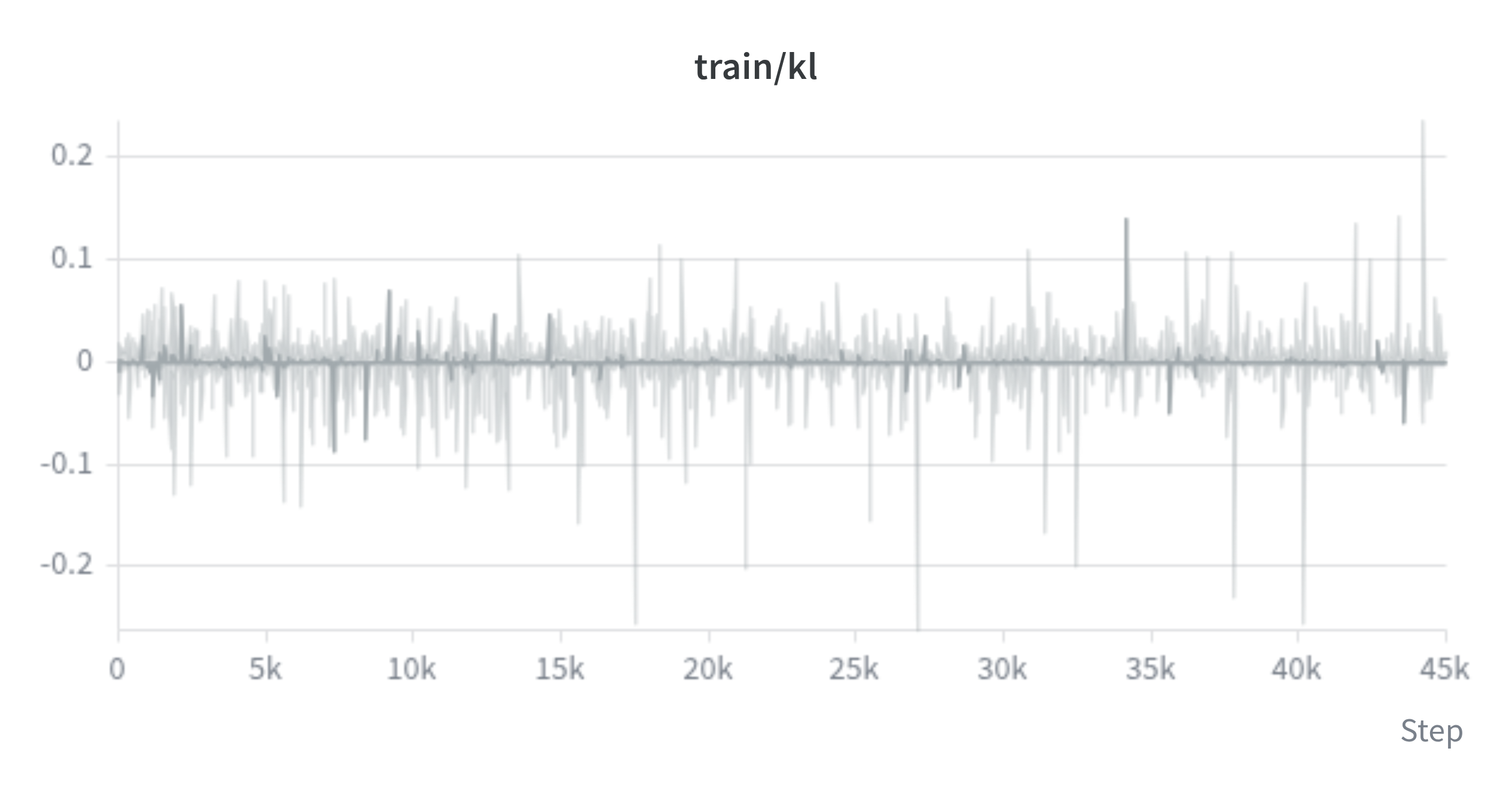
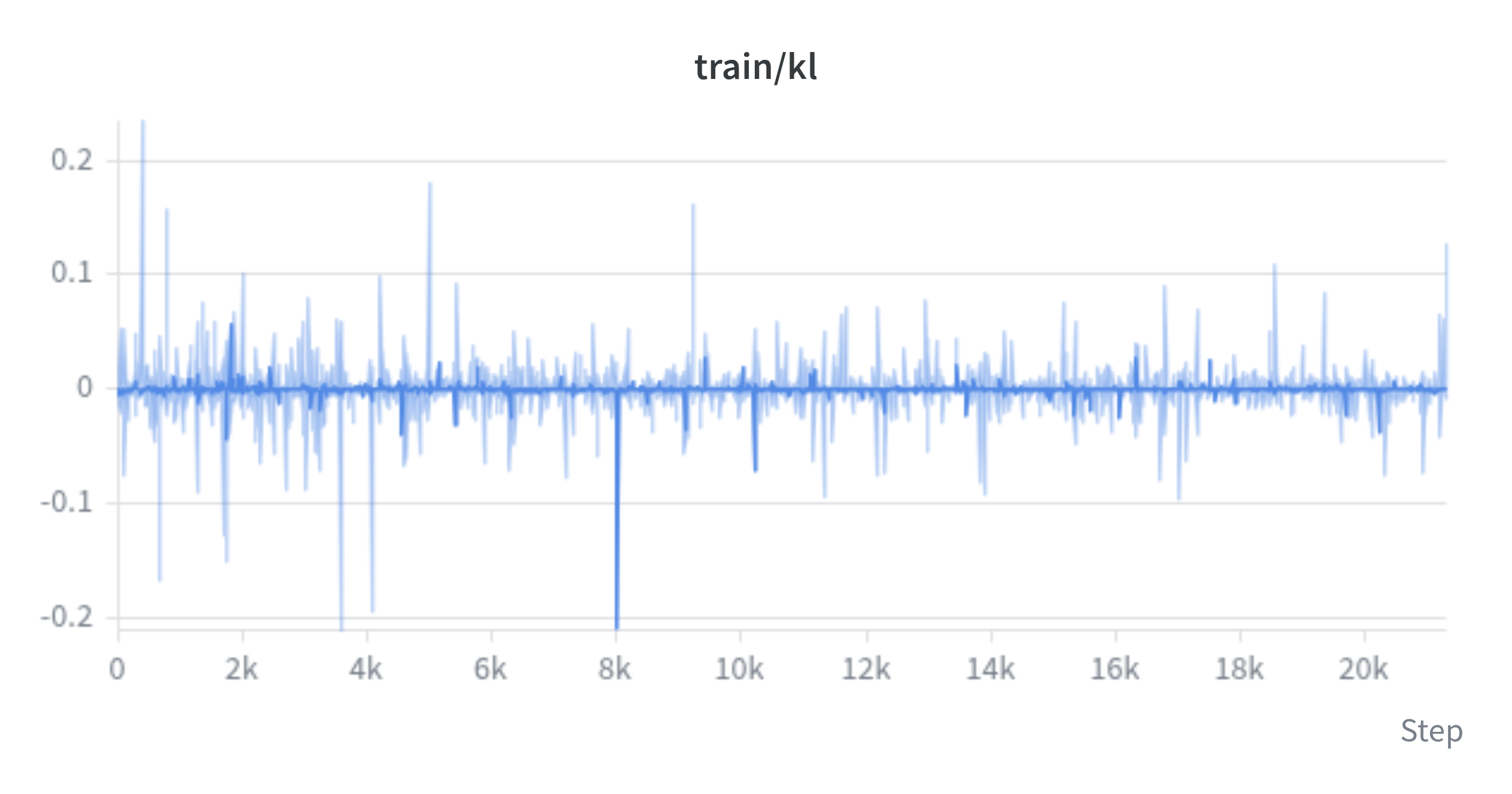
- What it teaches: Small epsilon → conservative steps, slower but stable. Large epsilon → closer to VPG, can still collapse. Also KL(old || new) should stay bounded by roughly epsilon on healthy runs.
The recurring signal across this whole phase: KL bounded by eps learns, KL past eps collapses. Every plot below is the same shape - train your eye here.
What we actually see:
| run | eps | lr | score_max | entropy_last | kl_max |
|---|---|---|---|---|---|
| eps0.1 | 0.1 | 1e-4 | 39.1 | 0.677 | 0.029 |
| eps0.2 | 0.2 | 1e-4 | 56.1 | 0.662 | 0.054 |
| eps0.3 | 0.3 | 3e-4 | 127.7 | 0.657 | 0.060 |
| eps0.1 | 0.1 | 5e-4 | 38.4 | 0.657 | 0.211 |
The lesson is not “lower lr.” It’s match the update size to the trust region:
- Wide trust region + moderate lr (eps 0.3, lr 3e-4) is the clear winner at ~127 - the biggest, most effective single update step so far.
- Tight eps + high lr (0.1, 5e-4) blows out the trust region: kl_max 0.211 is >2x its own eps, the policy is stepping too far each update and getting noisier (score 27 and falling).
- Entropy stays healthy everywhere (0.66-0.68), so clipping is doing its job - no collapse, just different step sizes.
So, KL bounded by eps is the clean signal, and the winner is the config whose step size uses the whole trust region without spilling past it.
exp3: add a value baseline and vary GAE
lr 1e-4 eps 0.1 lambda 0.95 gamma 0.98
lr 1e-4 eps 0.1 lambda 0.5 gamma 0.95
Why run it: The advantage estimator is where a lot of PPO’s sample efficiency comes from. Understand the bias-variance tradeoff.
What we see:
| run | eps | lr | lambda | gamma | score_max | entropy_last | grad_norm_max |
|---|---|---|---|---|---|---|---|
| eps0.1 lam0.95 gam0.98 | 0.1 | 1e-4 | 0.95 | 0.98 | 43.8 | 0.686 | 0.41 |
| eps0.1 lam0.5 gam0.95 | 0.1 | 1e-4 | 0.5 | 0.95 | 44.6 | 0.686 | 0.22 |
| eps0.3 lam0.95 gam0.98 | 0.3 | 3e-4 | 0.95 | 0.98 | 127.7 | 0.657 | 1.03 |
- What it teaches:
lambdaandgammacontrol the bias-variance tradeoff of the advantage estimate. Lowerlambda/gamma= higher-bias, lower-variance, but here it doesn’t move the needle much (44 vs 44.6). The eps/lr combo dominates - the best run is still the wide-eps + moderate-lr one from exp2. - grad_norm spikes to 1.0 in the strong run: the larger policy steps carry bigger gradients. That’s the cost of a wide trust region, worth watching but not fatal here (score still climbs to 127).
- Note
lambda=0.5 keeps grad_norm calmer (0.22) but trades away the extra sample efficiency - score plateaus lower. Classic bias-variance: tame gradients, weaker learning.
exp4: Entropy coefficient ablation
Base config eps0.3 / lr3e-4 / lam0.95 / gam0.98, vary entropy_coef ∈ {0.0, 0.001, 0.01, 0.05}:
What we see (reproduce with uv run python metrics.py r808tvkn bpx9paoi ck7185qs ah55c3qm):
| entropy_coef | score_max | score_last | entropy_mean | kl_max | grad_norm_max |
|---|---|---|---|---|---|
| 0.0 | 130.4 | 130.4 | 0.637 | 0.088 | 0.384 |
| 0.001 | 121.3 | 104.3 | 0.643 | 0.089 | 0.342 |
| 0.01 | 76.9 | 57.7 | 0.666 | 0.025 | 0.504 |
| 0.05 | 35.9 | 33.9 | 0.686 | 0.278 | 0.997 |
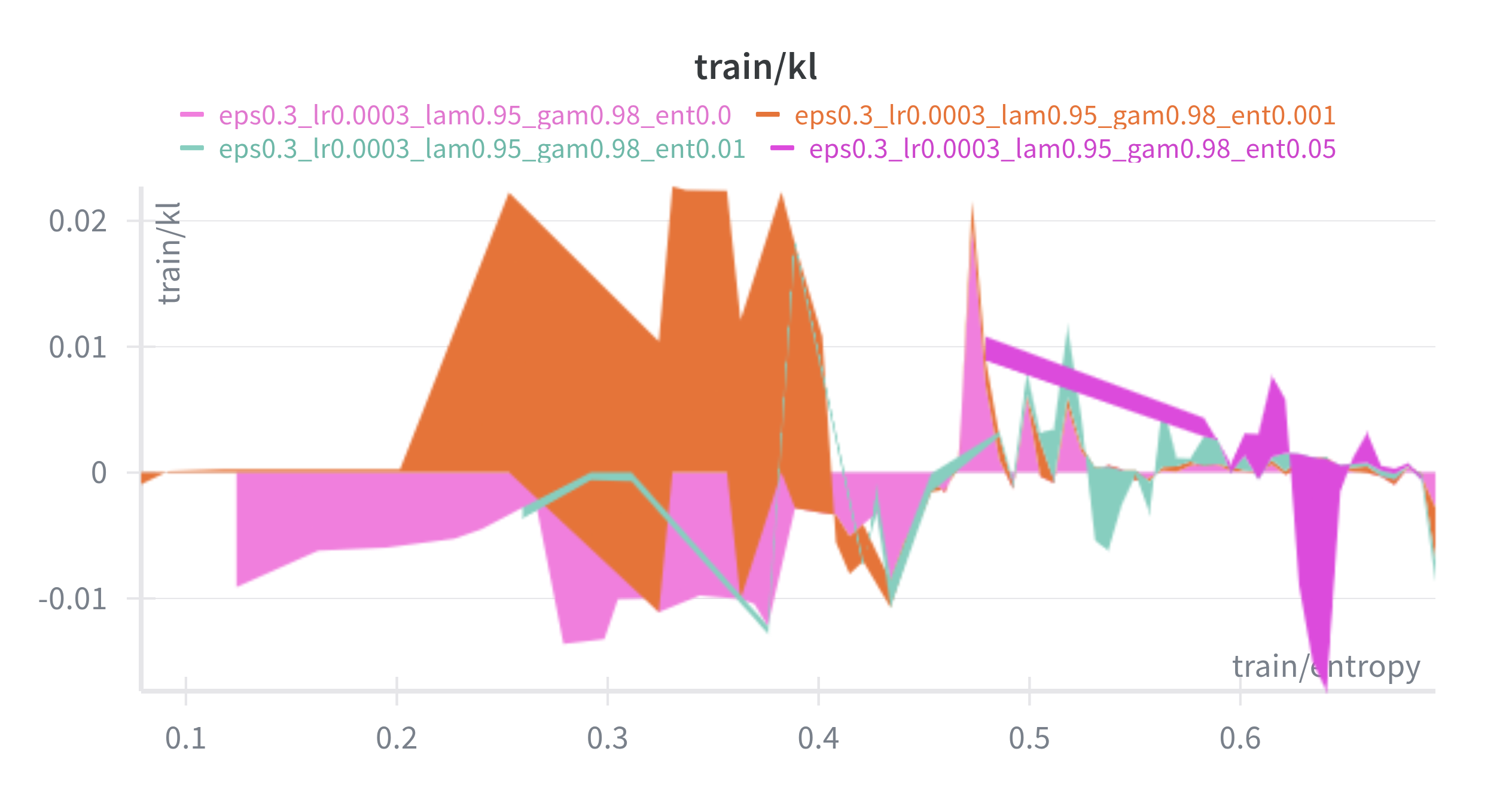
- The coefficient does what it’s told - entropy rises monotonically (0.637 → 0.686) with the coef. It just hurts here: score_max tanks 130 → 121 → 77 → 36.
- CartPole’s optimal policy is near-deterministic - forcing exploration with a high coef keeps the policy flailing, capping score at ~35.
- 0.001 is the only defensible nonzero value (121 vs 130, nearly a wash). 0.01+ is pure penalty.
- The 0.05 run shows the instability signature: grad_norm 0.997 and kl_max 0.278 (≫ eps) - the policy keeps re-randomizing, so each update fights the entropy term and produces big noisy steps.
- Caveat: a 2-action space is too small for entropy regularization to matter. Re-test on a richer discrete space or the continuous Pendulum / LLM phase.
exp5: batch size and update epochs
Base config eps0.3 / lr3e-4 / lam0.95 / gam0.98, vary epochs and batch_size:
What we see:
| run | epochs | batch_size | score_max | score_last | entropy_last | kl_max | grad_norm_max |
|---|---|---|---|---|---|---|---|
| ep3_bs20 (exp4 baseline) | 3 | 20 | 130.4 | 130.4 | 0.586 | 0.088 | 0.384 |
| ep4_bs20 | 4 | 20 | 159.8 | 159.8 | 0.606 | 0.171 | 0.706 |
| ep10_bs20 | 10 | 20 | 92.0 | 89.7 | 0.654 | 0.92 | 0.376 |
| ep3_bs32 | 3 | 32 | 177.1 | 114.4 | 0.619 | 0.195 | 0.687 |
| ep3_bs128 | 3 | 128 | 89.2 | 89.2 | 0.624 | 0.125 | 0.58 |
- More epochs is a double-edged sword. ep3→ep4 improves (130→160) - reusing experience helps. But ep3→ep10 collapses (130→92) and kl_max explodes to 0.92, ~3x the clip epsilon (0.3). Ten epochs drifts the policy so far from the collected data that the trust region is blown out. This is the textbook “overdo the reuse” failure.
- Larger batch hurts here, but not for the usual reason. With a fixed 20-step rollout, a batch of 128 re-samples the same 20 transitions ~6x per epoch (via
randperm). So bs128 isn’t “more data” - it’s the same tiny rollout seen many more times, overfitting the policy to a handful of transitions. That’s why it underperforms bs20/bs32. - The combination matters more than either knob (the experiment’s key claim): ep4_bs20 (159) and ep3_bs32 (177) both beat the baseline for different reasons - one reuses more, one sees a slightly bigger batch. The worst runs are the extremes: ep10 (too much reuse) and bs128 (too much re-sampling of a tiny rollout).
- KL bounded by eps is the health check again. Every run that stays bounded (kl_max ≲ 0.2) learns; the one that blows past eps (ep10, kl 0.92) collapses. Same lesson as exp2.
exp6: network size ablation
Base config eps0.3 / lr3e-4 / lam0.95 / gam0.98, vary hidden_units {32, 128, 512} × hidden_layers {1, 2}:
What we see (reproduce with uv run python metrics.py uwq3xkru 43z896f2 o7b9o09h 7sbswivb sviyis3a coi6l6i7):
| run | hu | hl | score_max | score_last | entropy_last | kl_max | grad_norm_max |
|---|---|---|---|---|---|---|---|
| hu32_hl1 | 32 | 1 | 116.7 | 116.7 | 0.670 | 0.028 | 0.494 |
| hu128_hl1 | 128 | 1 | 146.0 | 86.5 | 0.601 | 0.085 | 0.307 |
| hu512_hl1 | 512 | 1 | 124.8 | 124.8 | 0.596 | 0.147 | 0.439 |
| hu32_hl2 | 32 | 2 | 137.4 | 137.4 | 0.642 | 0.063 | 0.517 |
| hu128_hl2 | 128 | 2 | 79.1 | 79.1 | 0.665 | 0.073 | 0.739 |
| hu512_hl2 | 512 | 2 | 187.6 | 187.6 | 0.638 | 0.176 | 0.610 |
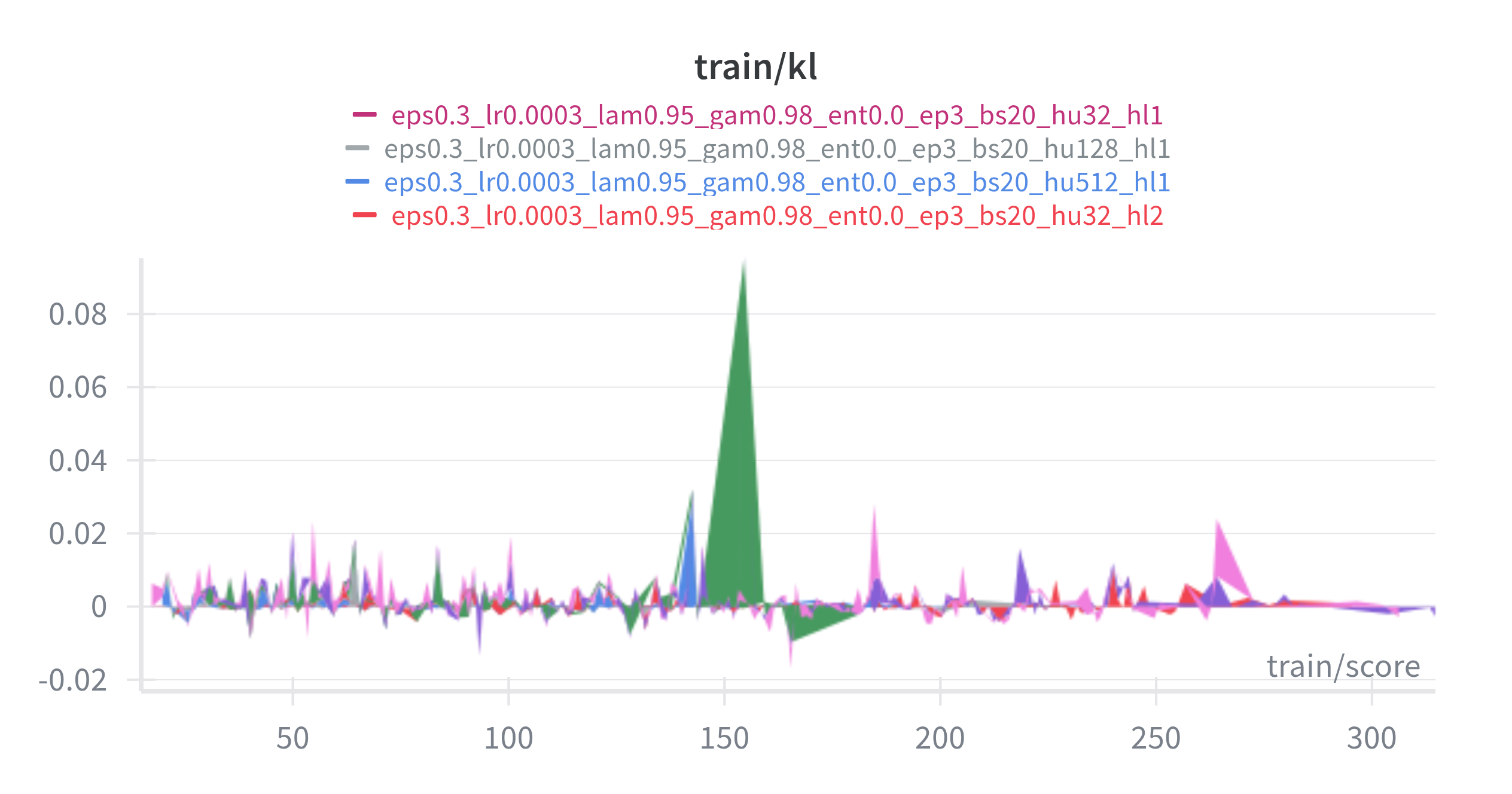
- Network size is essentially a non-factor on CartPole. All six runs land in the 79-188 band, straddling the 130 baseline (hu256_hl1 from exp4). No monotonic trend - the best (hu512_hl2, 188) and worst (hu128_hl2, 79) are both 2-layer, and the spread looks like seed noise, not signal.
- The smallest network is nearly as good as the best. hu32_hl1 (1315 params) hits 116.7, within ~10% of the baseline with a fraction of the parameters. This confirms the experiment’s hypothesis: CartPole saturates with a tiny network.
- kl_max and grad_norm grow with size (0.028→0.176, 0.3→0.7) but don’t buy score - just more churn. Bigger nets move the policy further per update without learning better.
- Lesson: on a task this simple, capacity is wasted. Use the smallest net that solves the task; save the big networks for Pendulum / the LLM phase where capacity will actually matter.
breadcrumbs
- rl-fundamentals - the advantage/GAE theory this experiment series implements
- rl notes - the policy-gradient half; the clip objective originates there
- orm/prm validation runs - the reward-model side of the same arc
todos
- next phases per exp6’s own conclusion: Pendulum and then the LLM phase, where network capacity actually matters.
- the exp6 observation that kl_max/grad_norm grow with size without buying score deserves one ablation with the KL coefficient varied - cheap and would close the loop.