


Segment Anything notes
Kirillov et al 2023: the paper that reframed segmentation from “train a model per dataset” to “train once, prompt forever”. the plan hangs on three components - task, model, data - and three questions:
- what task enables zero-shot generalization to new segmentation problems?
- what model supports that task?
- what data can power it?
answer: promptable segmentation - give the model an image + a prompt (point, box, mask, text) and it returns a segmentation mask, even without knowing what the object is. the design that satisfies all three constraints is deliberately boring: powerful image encoder → image embedding; lightweight prompt encoder → prompt embedding; combine in a light mask decoder that predicts masks.
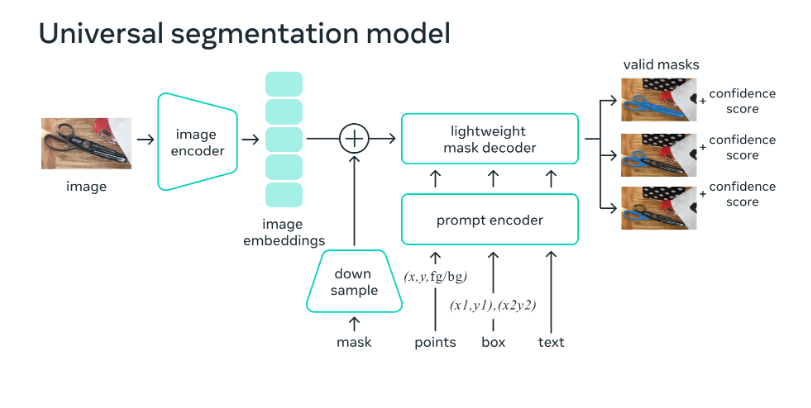
model design
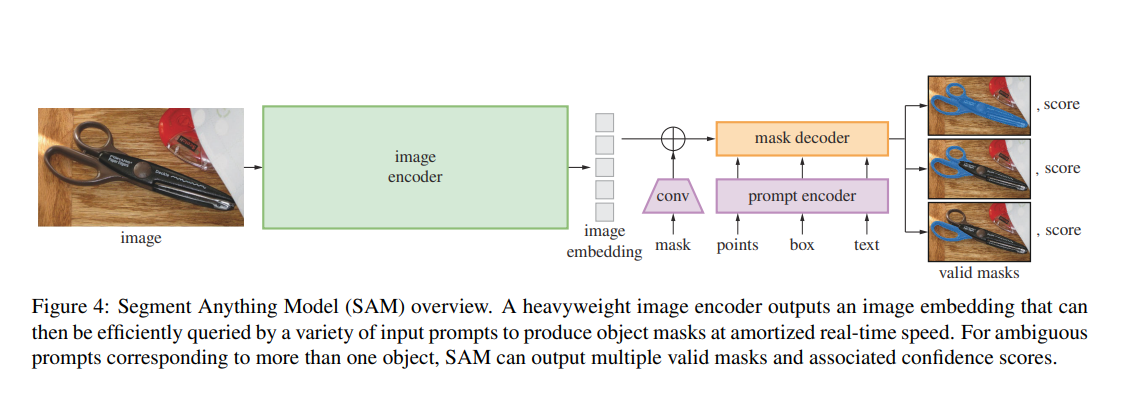
- image encoder: an MAE-pretrained ViT, minimally adapted for high-resolution inputs. runs once per image, before any prompting - prompts come cheap after this.
- prompt encoder: two sets of prompts - sparse (points, boxes, text) and dense (masks). points/boxes become positional encodings summed with learned per-type embeddings; free-form text goes through CLIP’s text encoder. dense mask prompts are embedded with convolutions and summed element-wise into the image embedding.
- mask decoder: maps image embedding + prompt embeddings + an output token to a mask. a modified transformer decoder block (the lineage is DETR and Mask2Former-style per-pixel-classification work) with two-way cross-attention (prompt↔image) prompt self-attention to update all embeddings. after two blocks: upsample the image embedding, and an MLP maps the output token to a dynamic linear classifier over mask channels.
- runtime is the point: with the image embedding precomputed, prompt encoder + mask decoder run in ~50 ms in a web browser, on CPU. that’s what makes interactive, real-time prompting possible.
resolving ambiguity - the clever bit
one output mask per prompt would average over several valid interpretations of an ambiguous prompt (is the point on a shirt the fiber, the shirt, or the person?). fix: predict 3 output masks per prompt - whole, part, subpart (ambiguous nesting rarely runs deeper than 3). during training, backprop only through the minimum-loss mask; each mask also gets a confidence score (predicted IoU) so the model can rank them at inference.
losses, training, and the data engine
supervision: linear combination of focal loss + dice loss (the focal+dice recipe DETR uses). training simulates interactivity: for each mask, sample geometric prompts in 11 rounds so SAM learns the full prompt→mask→refine loop.
the data engine, three stages, each feeding a retrain:
- model-assisted manual annotation: annotators click foreground/background points in a browser tool powered by SAM. annotating time drops from 34 s → 14 s per mask as the model improves.
- semi-automatic, prominent objects first: SAM proposes candidate masks; annotators add the missing prominent objects. 5.9 M masks added here, bringing the running total to ~10.2 M before retraining; the stage’s real function is hardening the model against confusion between classes and instances.
- fully automatic: prompt SAM with a 32×32 grid of points over every image, keep stable masks (mean confidence ≥0.5 ± δ), filter duplicates with NMS, plus zoomed-in crop augmentation for small objects.
the output: SA-1B - 11 M images and 1.1 B masks - released openly, masks of higher quality than fully-manual datasets, and the foundation of the zero-shot results.
zero-shot results (the part worth remembering)
- 23 segmentation datasets, single prompt-able model, compared against a per-dataset RITM: with a human-in-the-loop oracle, 16/23 improvements; fully automatic mask quality numbers trail the interactive setting.
- edges (BSDS500): prompt with a 16×16 foreground point grid → 16×16×3 = 768 candidate masks → filter → Sobel. low-input-resolution baselines still beat it there, but so do human disagreements.
- object proposals (as a proposal-generator stage for detection) and instance segmentation by prompting SAM with ViTDet boxes - composing SAM as a component of bigger systems, which is the usage pattern that stuck.
- text-to-mask: a proof-of-concept with a CLIP text encoder, foreshadowing the promptable-everything world.
takeaways
the lesson i keep: task/model/data designed together beat any single clever architecture. the architecture is deliberately unremarkable (ViT + small decoder); the task definition (promptability) and the data engine loop are the moat. this is also where my segmentation stack got its “foundation-model first” habit from.
papers & sources
- SAM: https://arxiv.org/abs/2304.02643 - project: https://segment-anything.com
- intro walkthrough: V7 Labs blog
todos
- SA-1B license + size-on-disk, and the SAM 2 (video, memory-attention) delta worth a second note.
- the text-to-mask experiment: the paper introduces it but my note never recorded the outcome - dig §D and write what actually happened.
- SAM’s limitations section (weak semantic grouping, no per-region semantics) - map it against the MLLA/segmentation notes.
- try SAM as a mask-prior generator for my own segmentation training loops - cheap win probably sitting there.