


webrtc notes
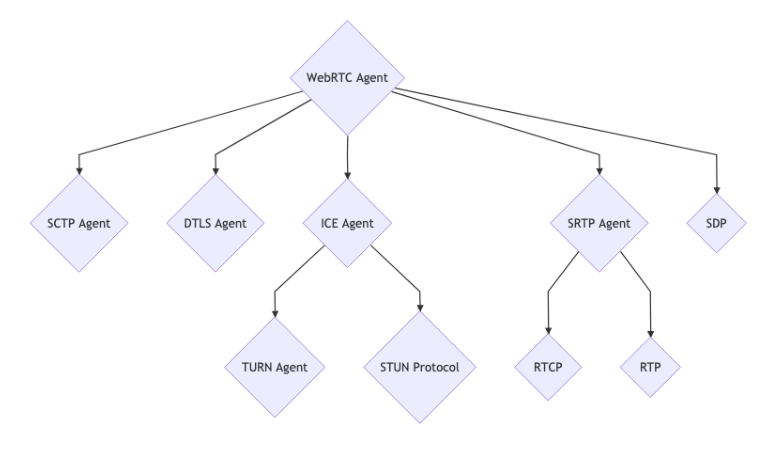
WebRTC is the set of rules two agents follow to negotiate bi-directional, secure, real-time communication. four sequential steps, each one gates the next:
- signaling - find your peer and agree on what you’re calling about
- connecting - punch through NAT with ICE/STUN/TURN
- securing - DTLS + SRTP over the connection
- communicating - RTP (media) and SCTP (data channels)
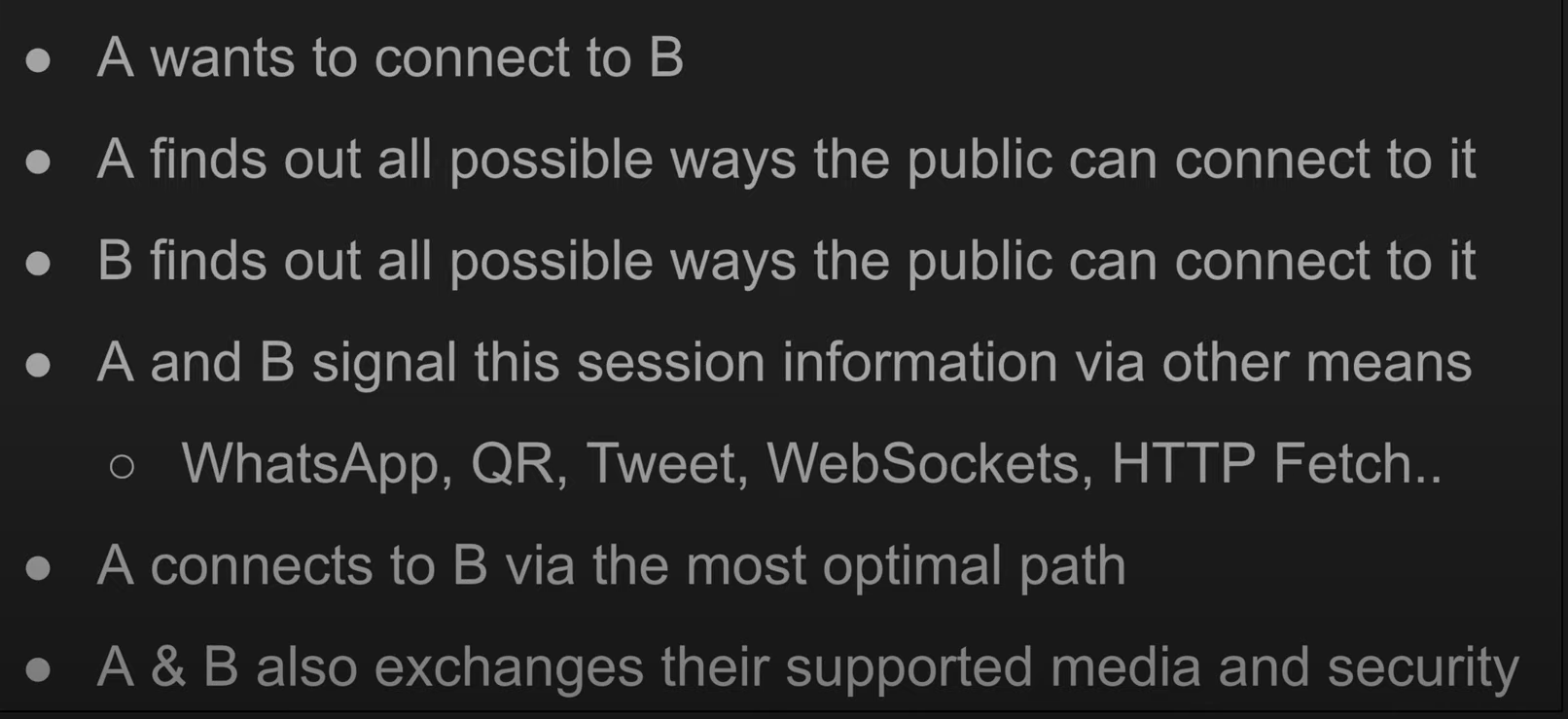
signaling
an agent starts knowing nothing - not who it will talk to, not about what. signaling bootstraps that. it runs over an existing plain-text protocol, SDP (Session Description Protocol): key/value lines with a list of media sections. the SDP the two agents exchange carries:
- reachable IPs/ports (the ICE candidates)
- how many audio/video tracks each side wants to send
- codec support
- the values used while connecting (
uFrag/uPwd) - the values used while securing (certificate fingerprint)
the part i keep forgetting: WebRTC does not define any of this transport. there must be some other channel between the peers before WebRTC starts, and the spec doesn’t care which. REST endpoints, WebSockets, even copy-paste by hand - anything that relays SDP works. every app builds its own signaling layer on existing infrastructure.
connecting: ICE, STUN, TURN
with SDPs exchanged, the agents try to actually reach each other. ICE (Interactive Connectivity Establishment) predates WebRTC and solves “peer A and peer B can’t directly connect” - firewalls block ports, most devices have no public IP, and some routers refuse direct connections. ICE enumerates every possible way to reach you by combining STUN and TURN servers, and hands the results over as ICE candidates.
- NAT: your router holds the public IP; devices behind it share it via private IPs and unique port mappings on translation. discovery works - until a router’s symmetry rules say otherwise.
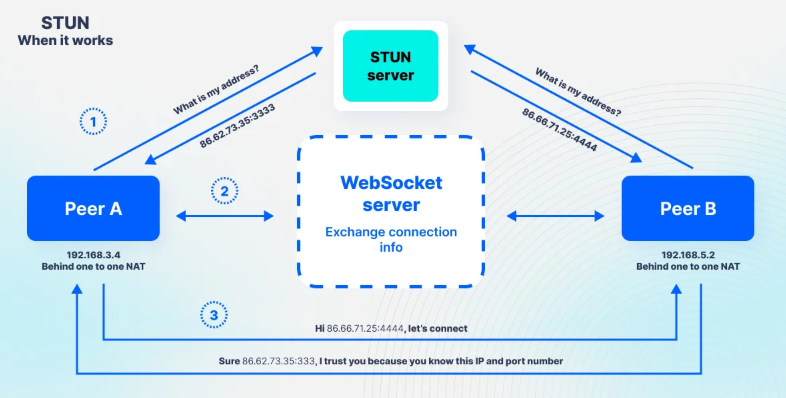
- STUN (Session Traversal Utilities for NAT): a server that tells you your own public address - the request goes out, the server replies with the source ip:port it saw, and whether your NAT looks permissive or restrictive. that’s all STUN does. (it never “establishes a UDP connection between two users”, as short definitions sometimes claim - STUN connects nothing to anyone; it just lets you learn your reflexive address so you can advertise it.) the public STUN endpoint everyone uses:
stun.l.google.com:19302.
- TURN (Traversal Using Relays around NAT): when STUN isn’t enough - classic case: symmetric NAT, where the router only accepts traffic on a previously used mapping, so the address STUN gave you is useless to the peer. TURN relays every packet through a server both peers can reach. works everywhere, costs bandwidth and money on the server side, so it’s the fallback, not the default.
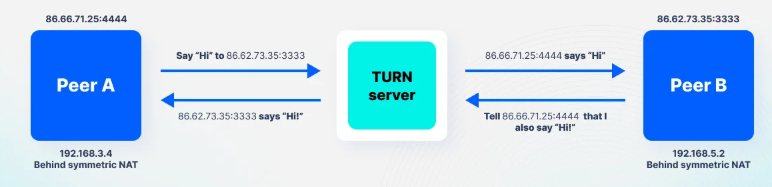
ICE candidates - the concrete “ways to reach me” that get exchanged - come in three types worth naming: host (your LAN address), srflx (the STUN-discovered public mapping), relay (the TURN server). peers nominate pairs in priority order, host/srflx before relay; ICE’s controlling agent picks the winning pair and signals it, the controlled agent obeys. UDP candidates are preferred (faster, and media recovers from loss), TCP exists as a fallback.
securing: DTLS and SRTP
bi-directional transport isn’t yet trust. two layers, each with a job:
- DTLS (Datagram TLS) is TLS over the UDP connection, done as a handshake right after ICE succeeds. here WebRTC diverges from HTTPS: no certificate authority. your peer asserts: the certificate you presented over DTLS must match the fingerprint we already exchanged in SDP during signaling. if the fingerprints line up, identity is pinned to the signaling exchange itself.
- SRTP (Secure RTP) encrypts the actual media packets, keyed from the negotiated DTLS session.
data channels ride the DTLS connection; media rides SRTP.
communicating: RTP and SCTP
- RTP moves the media, encrypted via SRTP. it sequence-numbers and timestamps packets so reassembly works on unreliable transports; it’s usually UDP underneath for low latency, and its own header carries the metadata (payload type, sequence, timestamp) reordering needs.
- SCTP carries DataChannel messages (encrypted via DTLS) - arbitrary bidirectional data: text, files, game state, back-channel metadata.
- both protocols hand you the latency/packet-loss tradeoffs: media can survive dropped frames, data channels generally can’t.
the API core
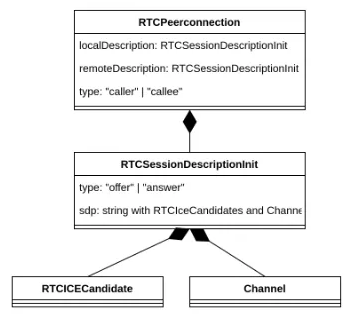
every peer gets an RTCPeerConnection. each one carries a localDescription and a remoteDescription (of type RTCSessionDescriptionInit):
localDescription= what this peer can exchange (media/data channels) and how it can be reached (ICE candidates)remoteDescription= the same for the other peer- each is typed
offer(the caller created it) oranswer(the callee did), and wraps an SDP string
the full offer/answer dance, step by step:
- caller captures media via
getUserMedia - creates
RTCPeerConnection, attaches tracks withaddTrack()(addStreamis deprecated) - calls
createOffer() setLocalDescription(offer)- then ICE gathers candidates (asynchronously, using the STUN/TURN servers from the config - which is why you wait for gathering if you want the candidates inside the SDP rather than trickled)- caller relays the offer via the signaling channel
- callee receives, calls
setRemoteDescription(offer), does its own setup (capture media,addTrack) createAnswer(),setLocalDescription(answer), relay the answer back- caller:
setRemoteDescription(answer)- both sides now know both configurations, media flows - ICE candidate exchange continues alongside: each
icecandidateevent gets sent to the peer and fed intoaddIceCandidate()
a minimal, self-consistent caller setup, with the real public STUN host:
const rtcConfig = { iceServers: [{ urls: 'stun:stun.l.google.com:19302' }] };

const peerConnection = new RTCPeerConnection(rtcConfig);

// candidates the ICE agent discovers, relay each to the peer
peerConnection.onicecandidate = ({ candidate }) => {
  if (candidate) signaling.send(JSON.stringify({ type: 'candidate', candidate }));
};

peerConnection.onconnectionstatechange = () =>
  console.log(peerConnection.connectionState);

const offer = await peerConnection.createOffer();
await peerConnection.setLocalDescription(offer);   // ICE gathering starts here
signaling.send(JSON.stringify({ type: 'offer', sdp: peerConnection.localDescription }));

// ... later, when the answer arrives through signaling:
await peerConnection.setRemoteDescription(answer);
close() tears down active streams and ICE processing and releases everything the connection holds.
media plumbing comes in three flavors: RTCRtpSender (encode + transmit a MediaStreamTrack), RTCRtpReceiver (inspect incoming tracks), and RTCRtpTransceiver (a sender+receiver pair sharing one SDP mid, i.e. one bidirectional SRTP stream), via getSenders()/getReceivers()/getTransceivers().
data channels are deliberately boring:
const dataChannel = peerConnection.createDataChannel('sendDataChannel');
dataChannel.send(textarea.value);   // accepts string, Blob, ArrayBuffer, TypedArray, DataView
dataChannel.onopen = () => console.log(dataChannel.readyState); // 'open'
dataChannel.onclose = () => console.log('closed');
on the signaling server side, because it’s not part of the API, one small node/socket.io relay does the whole job - rooms plus three forwarded messages. (the common tutorial version declares express twice and broadcasts offers to every connected socket; forwarding scoped to the room is the obvious fix):
io.on('connection', socket => {
  socket.on('join', ({ room, name }) => {
    socket.join(room);
    socketToRoom[socket.id] = room;
    (rooms[room] ??= []).push({ id: socket.id, name });
    socket.emit('room_users', rooms[room].filter(u => u.id !== socket.id));
  });

  socket.on('offer', sdp => socket.broadcast.to(socketToRoom[socket.id]).emit('getOffer', sdp));
  socket.on('answer', sdp => socket.broadcast.to(socketToRoom[socket.id]).emit('getAnswer', sdp));
  socket.on('candidate', c => socket.broadcast.to(socketToRoom[socket.id]).emit('getCandidate', c));

  socket.on('disconnect', () => {
    const room = rooms[socketToRoom[socket.id]];
    if (room) {
      rooms[socketToRoom[socket.id]] = room.filter(u => u.id !== socket.id);
      socket.broadcast.to(socketToRoom[socket.id]).emit('user_exit', { id: socket.id });
    }
  });
});
SDP format, briefly
one media session, dissected:
v=0
o=jdoe 2890844526 2890842807 IN IP4 10.47.16.5
s=SDP Seminar
c=IN IP4 224.2.17.12/127
t=2873397496 2873404696
m=audio 49170 RTP/AVP 0
m=video 51372 RTP/AVP 99
a=rtpmap:99 h263-1998/90000
vprotocol version,osession originator + identifier,ssession name,cconnection info,ttiming,aattributes- media lines expand as
m=<media> <port> <proto> <fmt>: media ∈ {audio, video, text, application, message}; proto like UDP/RTP/AVP/RTP/SAVP;fmtcarries RTP payload type numbers when the proto is RTP-based
full grammar: RFC 4566. RTP itself: RFC 3550.
why udp for media
the transport underneath everything: TCP is connection-oriented with guaranteed, ordered, error-corrected delivery (resends lost packets) - right for browsing, wrong for a call, where a late packet is a stale packet. UDP is connectionless and unguaranteed - perfect where freshest-wins beats eventual-consistency: streaming media, real-time games. RTP over UDP plus sequence numbers gives you just enough order to reassemble, and never waits on a retransmit.
security
DTLS handles the channels and key exchange; SRTP covers message authentication, integrity, and replay protection of the RTP stream. browsers enforce both for WebRTC media; do the same for data channels, and never ship a peer connection without its fingerprint checks wired.
sources
- MDN WebRTC API (most of the API + protocol sections paraphrase it): https://developer.mozilla.org/en-US/docs/Web/API/WebRTC_API
- the book i should read cover to cover: https://webrtcforthecurious.com/
- getstream’s webrtc guide: https://getstream.io/resources/projects/webrtc/
- hands-on: fastapi webrtc series, js+python snippets, video walkthrough
todos
- TURN server setup + pricing reality (coturn is the reference implementation; i’ve never deployed one).
- SDP munging and why it breaks - when you can’t just edit the offer.
- simulcast / svc layers for multi-party calls - the piece none of these notes touch yet.