

RoPE notes
I owe a debt of gratitude to this dude for making RoPE click for me
so BERT and GPT-2 just add the position vector to the token vector \(\vec{v}_{\text{token}} + \vec{v}_{\text{pos}}\). the whole thing is one move (rotate) done in a way that turns position into an angle, and angles add.
the whole idea answers four questions in order, and each answer hands you the next one.
1. How do you turn position into an angle?
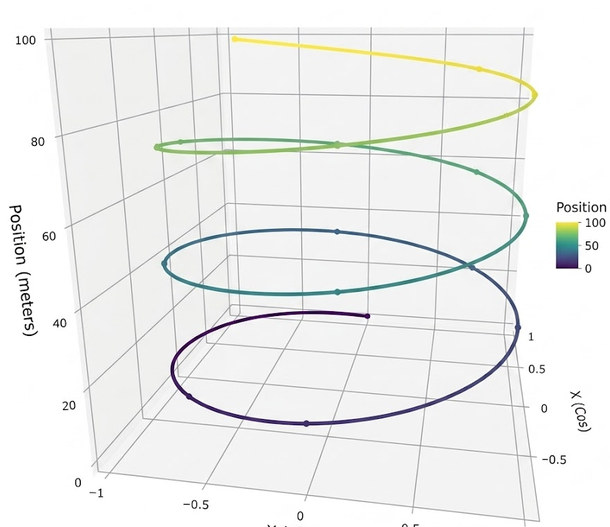
scale it linearly. for position index $m$, the angle is $m \cdot \theta$ - position times some base angle $\theta$. walk forward in position, you spin around:
| pos $m$ | angle | rotation |
|---|---|---|
| 0 | $0$ | no spin |
| 1 | $\theta$ | one spin |
| 2 | $2\theta$ | two spins |
| 3 | $3\theta$ | three spins |
| $m$ | $m\theta$ | $m$ spins |
geometrically this traces a helix in vector space.
the rotation itself is the 2D matrix:
\[R(\theta) = \begin{bmatrix} \cos\theta & -\sin\theta \\ \sin\theta & \cos\theta \end{bmatrix}\]worked example. $v = \begin{bmatrix} 1 \ 2 \end{bmatrix}$, rotated by $\theta = \frac{\pi}{2}$ ($90^\circ$). $\cos\frac{\pi}{2} = 0$, $\sin\frac{\pi}{2} = 1$, so:
\[R\!\left(\tfrac{\pi}{2}\right) = \begin{bmatrix} 0 & -1 \\ 1 & 0 \end{bmatrix}, \qquad v' = \begin{bmatrix} 0 & -1 \\ 1 & 0 \end{bmatrix}\begin{bmatrix} 1 \\ 2 \end{bmatrix} = \begin{bmatrix} -2 \\ 1 \end{bmatrix}\]$\lVert v \rVert = \sqrt{1+4} = \sqrt{5}$, $\lVert v’ \rVert = \sqrt{4+1} = \sqrt{5}$. magnitude preserved, only the angle moved. that’s the whole point. the semantic content is the magnitude, the position is the angle, and rotating keeps one while moving the other.
a real hidden state is $d$-dimensional, not 2D. how does this scale?
2. How do you rotate a big-dimensional vector?
split it into 2D pairs and rotate each one. a $d$-dim vector is just $d/2$ stacked 2D planes:
\[[(x_0, x_1),\; (x_2, x_3),\; \dots,\; (x_{d-2}, x_{d-1})]\]rotate each pair with its own $R$. the 2D trick from §1 scales by copy-paste. $d/2$ independent little rotations, one per plane.
clean. but there’s a problem. if every pair rotates by the same $\theta$, all pairs are identical. pair $i$ and pair $j$ spin in lockstep, so the model can’t tell them apart. every pair carries the same positional signal. that’s useless.
3. How do you make each pair unique?
give each pair $i$ a different frequency $\theta_i$. a frequency here is essentially just a number attached to the pair to make it unique. how fast that particular pair spins per step of position.
\[\theta_i = 10000^{-2i/d}\]how fast does the $i$-th pair rotate? walk the formula:
- $i = 0$: $\theta_0 = 10000^{0} = 1$ → rotates fastest, one full unit per position step. short-range.
- $i \to d/2$: $\theta_i \to 10000^{-1} \approx 0.0001$ → barely moves. long-range.
so the spectrum goes $fast → slow$ across the pairs. one half of your hidden state is a fast-rotating clock, the other half barely moves. short-range dependencies read off the fast pairs, long-range off the slow ones. neat split.
algorithm steps:
- calculate base frequencies $\theta_i = 10000^{-2i/d}$ for each pair $i$.
- compute total angle $\alpha = m \cdot \theta_i$ (position × frequency - §1’s move, now per-pair).
- rotate each pair: \((x'_{2i},\, x'_{2i+1}) = \text{Rotate}(x_{2i},\, x_{2i+1},\, \alpha)\).
ok so we’ve turned position into per-pair angles. applying this to our core attention operation.
4. Does relative distance actually fall out?
query $q$ at position $m$ becomes $q’ = R(m\theta)\,q$, key $k$ at position $n$ becomes $k’ = R(n\theta)\,k$. the dot-product attention score between them:
\[\text{score} = q'^{\top} k' = q^{\top} R(m\theta)^{\top} R(n\theta)\, k\]apply the rotation identities $R(\alpha)^{\top} = R(-\alpha)$ and $R(\alpha)R(\beta) = R(\alpha + \beta)$:
\[R(m\theta)^{\top} R(n\theta) = R(-m\theta)\, R(n\theta) = R\!\big((n - m)\theta\big)\]so:
\[\text{score} = q^{\top} R\!\big((n - m)\theta\big)\, k\]the inner product depends only on $(n - m)$, the relative distance. no explicit relative position bias term needed.
5. PyTorch: make it fast
coda, not part of the intuition chain. just how you avoid paying for what you can precompute.
precompute the cache. precalculate $\text{inv_freq} = 10000^{-2i/d}$, outer-product with position indices $m$, and cache the $\sin$ and $\cos$ matrices so the whole thing can JIT-compile. positions are known up front, frequencies are known up front. no reason to recompute them in the forward pass.
fast vectorized rotation. instead of doing explicit 2D matrix multiplications, rewrite the standard rotation math. the definition:
\[x'_0 = x_0 \cos\alpha - x_1 \sin\alpha, \qquad x'_1 = x_0 \sin\alpha + x_1 \cos\alpha\]rearrange so each output is a linear combination with the same pair:
\[x'_0 = x_0 \cos\alpha + (-x_1) \sin\alpha, \qquad x'_1 = x_1 \cos\alpha + x_0 \sin\alpha\]now read it as elementwise: take $[x_0, x_1]$ and $[-x_1, x_0]$ (swap the pairs and negate the first element), then
\[[x'_0,\, x'_1] = [x_0,\, x_1] \odot \cos\alpha \;+\; [-x_1,\, x_0] \odot \sin\alpha\]all elementwise muls against the precomputed $\cos$ and $\sin$ tensors. no matmul, no gather. the rotation is just a swap-negate plus two elementwise products. done.
breadcrumbs
- bert notes - the positional-embedding contrast (learned absolute vs this rotational scheme)
- adamw kernel exercise - same fast-kernel arc
- softmax part 1 - elementwise-coalescing craft that this note’s fast path leans on
todos
- second half: position scaling extensions (NTK/YaRN-style) - the note stops at plain RoPE.
- verify the pair-allocation scheme at odd hidden dims (the leftover dim-1 pairing edge case) against the paper.
- the elementwise fast path deserves a fused RoPE+attention kernel write-up, matching the softmax arc.