


BERT notes
Devlin et al: pretraining that fuses context from both directions at the same time. the argument it opens with (still worth internalizing): standard language models are unidirectional, which restricts what architectures you can even choose during pretraining. GPT’s left-to-right attention is sub-optimal for sentence-level tasks and actively harmful for token-level tasks like question answering, where you crucially need context from both sides.
the fix that came to be called Masked LM: instead of predicting the next word, randomly mask words in the sentence and predict them from the full surrounding context - left and right simultaneously. the older “combine a left-to-right and a right-to-left model” approaches (ELMo’s two LSTMs) were missing this same-time part - two half-blind models that don’t talk to each other, doing sub-optimal work. (pedantic point that i still like: “non-directional” is actually more accurate than “bidirectional”.)
one note on the word novel: MLM as a technique is the Cloze task (Taylor 1953); what BERT made novel is running it as the scaled pretraining objective on a huge corpus. credit where due.
pre-training task 1: masked lm
why can’t you just train a bidirectional conditional model? because bidirectional conditioning lets every word indirectly see itself - in a deep stack the target word can be trivially copied through the layers. masking breaks that identity leakage.
the procedure:
- mask 15% of token positions at random; run the whole sequence through the deep bidirectional encoder; predict only the masked tokens (the original vocabulary ID, cross-entropy loss). e.g. input
the man went to the MASK1 . he bought a MASK2 of milk.→ labelsstore/gallon.
here’s the subtlety that i think explains half of BERT’s behavior: masked-predict creates a pretraining/fine-tuning mismatch - [MASK] never appears in fine-tuning. the mitigation is the 80/10/10 rule for each chosen token:
[MASK]80%- a random token 10%
- the unchanged token 10%
keeping 10% unchanged forces the representations to stay faithful to every token, since only ~1.5% of tokens are visibly corrupted but 15% are targets. and the 10% random tokens tax the model for guessing “same word” when the input was swapped.
this also explains the bank example: unidirectionally, bank in i made a bank deposit sees only i made a. BERT represents it from i made a ... deposit from the bottom of the network - deeply bidirectional, not a shallow concat of two context models.
pre-training task 2: nsp (with a modern asterisk)
second task from any monolingual corpus: are two sentences connected, or random?
the man went to the store . | he bought a gallon of milk .→ IsNextSentence (50% of pairs)the man went to the store . | penguins are flightless .→ NotNextSentence (the other 50%)
modern asterisk: NSP is deprecated practice - RoBERTa dropped it and matched/beating BERT with sentence-pair packing (full contiguous documents) instead, blaming NSP for hurting generalization. keep it in the historical picture, not the recipe.
the input decorations
only the encoder half of the transformer is used. inputs get three kinds of metadata before processing:
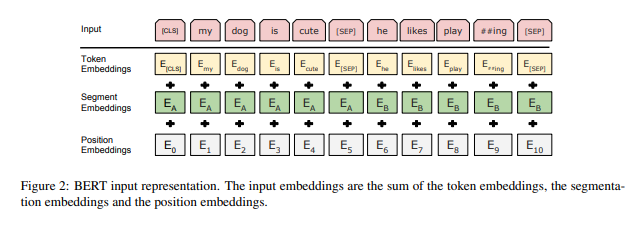
- token embeddings with
[CLS]prepended to the first sentence and[SEP]after each sentence - segment embeddings marking sentence A or B on each token
- positional embeddings marking position
the [CLS] token’s final hidden state becomes a summary vector - that’s the anchor for sentence-level tasks (the pooler runs a small MLP on it).
fine-tuning
initialize from pretrained parameters, then fine-tune all of them on labeled downstream data - one fine-tuned model per task, all sharing the same pretrained init. the task head is the only new thing: classification = [CLS] vector + a classifier layer; token-level tasks (NER, QA spans) = per-token vectors + classifiers; feature-based usage = feed BERT’s hidden states into a task-specific architecture instead of fine-tuning. training corpus: BooksCorpus + English Wikipedia.
sizes
- BERT-Base: 12 layers, 768 hidden, 12 heads, 110M params
- BERT-Large: 24 layers, 1024 hidden, 16 heads, 340M params
- trained on 4 cloud TPUs (Base) / 16 TPUs (Large) for 4 days each
wordpiece tokenization
I like surfboarding! → ['[CLS]', 'i', 'like', 'surf', '##board', '##ing', '!', '[SEP]'] → [1, 48, 250, 4033, 3588, 154, 5, 2]
every BERT input starts with [CLS] and ends with [SEP]. wordpiece splits words into frequent-character-pair chunks; unlike BPE it scores each candidate pair by:
dividing by the product of the parts’ own frequencies prioritizes merges whose parts are individually rare - so ("un", "##able") merges reluctantly (both are common on their own) while ("hu", "##gging") merges fast. (HuggingFace NLP course ch.6 explanation above.)
breadcrumbs
- lineage: word2vec gave static per-word embeddings; ELMo made them shallowly contextual; BERT made them deeply contextual. from word2vec to BERT is “one vector per word” → “one vector per occurrence”.
- the attention mechanism itself is the same as GPT’s - just bidirectional rather than causal. where did attention start? my Bahdanau attention notes predate both by four years.
- i also have a hands-on BERT worklog: pr1-luminal-bert (open-source example work).
- code: build BERT from scratch walkthrough, pytorch_bert and BERT-pytorch
papers & sources
- BERT: https://arxiv.org/abs/1810.04805
- RoBERTa (the NSP removal): https://arxiv.org/abs/1907.11692
- talks: Yannic Kilcher, another walkthrough
- my secondary sources: Samia Khalid’s guide, HuggingFace course, sentence-transformers
todos
- the pretraining loss itself (masked cross-entropy) and Q/K/V self-attention mechanics: the attention mechanics now live in transformers notes; the BERT-specific §3.1 fill is what’s still pending here.
- sentence-transformer pooling strategies (the UKPLab repo link was sitting in Sources unused) - what exactly does mean-pooling do to
[CLS]-trained representations?